
where were you today?
Or Taking the long way around to get to the point

I admit, I am long-winded. I don’t believe in elevator pitches. I don’t really know how to do small talk. When I am telling a story, I like to include as many details as I think are relevant to the telling, whether or not they are actually serving the story. When I was in high school, my English teachers would often write on my essays something along the lines of “But what is the main idea?” because I would so frequently follow detours that took me away from it.
Needless to say, having a short-form poetry practice is pointedly antithetical to this trait of mine. It forces invites economy, efficiency, and most of all having a point and getting there.
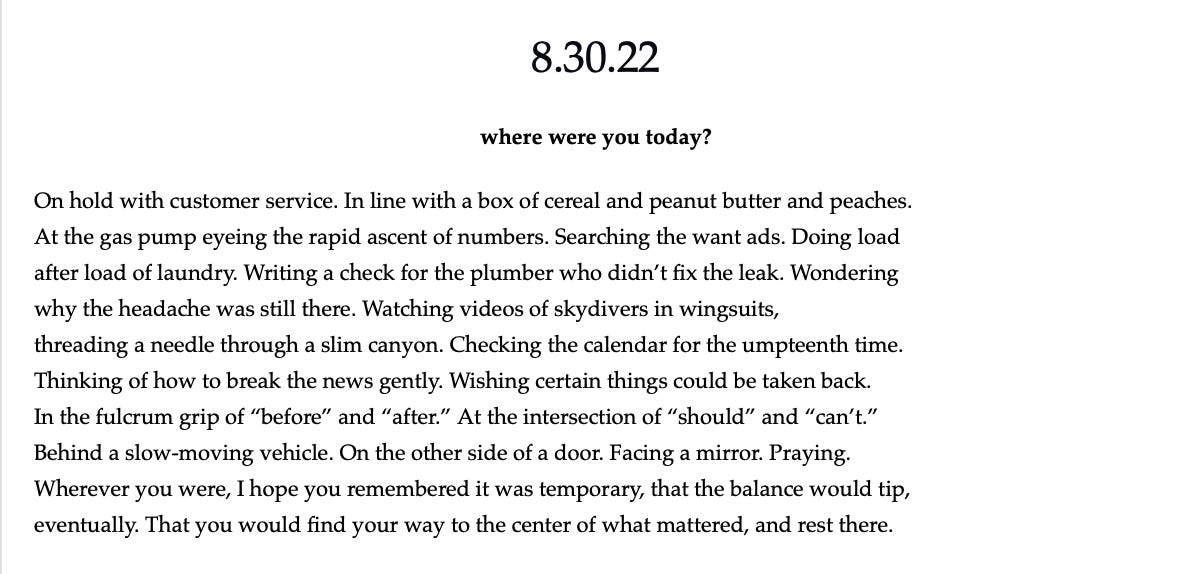
Still, despite the inherent discipline of fitting a poem into the span of 10 lines, I nevertheless look for opportunities for expansion within that limitation. In this week’s poem, for example, I’m including a multitude of contexts to set the stage for the framework of the poem, as well as to help elucidate the point I’m trying to make.
A little backstory first. I started with this picture of a bumble bee on a coneflower.
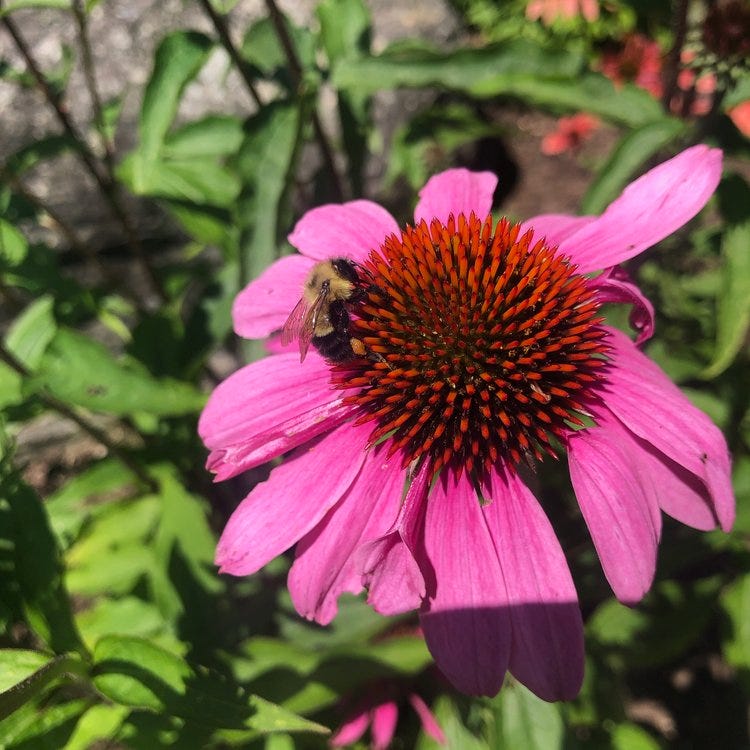
I looked at it for quite a long time. I backed away, softening my gaze (as I like to put it) to see if I could also see what wasn’t there, because for me, absence is often where a poem begins. Was there something happening or not happening in the photograph that corresponded or spoke to a need state? Was there a message to be eked out from an animal instinct that would drive a bee toward the center of a flower? How could I relate to that? If this were a metaphor for something, what would it be?
I often begin my poems by asking questions like these. I’m trying to discern the map of where poem is asking me to go.
What I saw was that the actions of this bee, regardless of any apian instincts (that basically didn’t give the bee much of a choice other than to do exactly what it was doing), held some simple but powerful guidance. The point was that the bee knew where the nectar was. It didn’t go hunting and pecking at the petals. It moved away from the perimeter and into the center.
So that’s when I drew my gaze further out and thought about contexts in which we are doing a thing that keeps us away from our own center, from the nectar of our lives. And of course there are all sorts of occasions like these. Certain ones I mention - being on hold, in line at the grocery store, losing oneself in social media entertainments, in traffic - perhaps don’t feel especially meaningful (or avoidable). But others - that “fulcrum grip of ‘before’ and ‘after’ and “the intersection of ‘should’ and ‘can’t” have a different quality to them. Even “facing a mirror.” They’re about a deeper, and often more difficult self-reflection. They are about making an honest inventory about what matters, and why it might be hard for us to lean toward it. And they are about meeting fear or uncertainty without knowing what’s on the other side.
I kept thinking about the bee in the photograph, imagining it a sort of guru. What would it tell us about where we might put our attention…or, at the very least, how to think about where were currently putting our attention?
I realize that you don’t have to tell the whole story to get your point across. The gift of this practice is that I can make inferences, write fragments, use phrasings that don’t have to stretch to the edge of the canvas completely. Words and images that show, as my high school English teachers nudged me to see, the main idea. The contexts I provided are the bare outlines, and that’s the point. They aim to connect the dots without having to fill in specifics, because in the case of this poem, it’s the action that matters, and not the minutiae of details.
I’m still a long-winded person. But I am, perhaps, a stubborn bee of a different sort, as the exploration of an idea (for me) is so very often the point. Thankfully, my poetry practice offers me a way to explore the tendrils at the perimeter while reminding me to keep nosing my way forward. And I keep sniffing, because - and this I’m pretty sure of - the flowers are everywhere.